Thursday, April 09, 2009

Wife of Chinese Rights Lawyer Appeals for Husband's Safety

By Yu Xiao
Epoch Times Staff Apr 8, 2009
Print E-mail


In a press conference held on April 6 in the New York, Ms. Geng He, wife of renowned Chinese rights attorney Gao Zhisheng (right) appealed for international attention to her husband’s situation and urged the regime to release him (Dai Bin/The Epoch Times)
Gao Zhisheng

NEW YORK--Geng He, the wife of renowned Chinese rights lawyer Gao Zhisheng, appealed for her abducted husband's safety in China. She spoke at a press conference at the New York Chinese Consolidated Benevolent Association on April 6.

Geng and her two children escaped to New York on March 11, but so far, no one knows Gao’s whereabouts since the Chinese communist regime abducted him from his home again on February 4.

At the conference, Geng described her family’s ordeal. "We lived on the second floor. There were two or three policemen guarding at my door on the first and third floor. The one-story unit at the apartment building was guarded by the police round the clock. There were also police in my apartment. Every single movement of ours was under their surveillance, including using the toilet and the bathroom. When we went to bed, the police would sit next to us, and we weren’t allowed to switch off the lights. The children were unable to sleep even when they were sleepy.” Her younger child, a boy, is five years old.

The elder daughter, now 16, suffered much mental anguish. “They banned my daughter from school, and she tried to commit suicide because of this. When I found this out, I totally collapsed. I decided to run for the sake of the kids,” Geng said. The family was able to escape China via a network of supporters.

Gao's Torture

On February 8, Gao’s overseas friend published an article written by Gao on November 28, 2007, which described the physical and mental torture he suffered during his last police abduction. For years, his wife and two children were under 24-hour police surveillance.

Geng said that her husband suffered many health problems due to the long term torture. His eyes kept tearing up because of smoke torture. He can hardly read books for half an hour because his vision becomes blurred. Because of a lower back problem resulting from torture, he could not get up from bed. His digestive system suffers also; he lost the ability to gauge whether his stomach is full or not, so sometimes he vomits because he doesn’t know to stop eating.

In 2005, Gao published three open letters to the Chinese regime to urge it to end its persecution of the spiritual practice Falun Gong. The facts Gao presented in the letters were gathered during his 15-day investigation of the persecution. Despite the consequences, the family stands behind Gao’s mission to advocate for Falun Gong’s rights. “I support his choice and his values. The children and I are all behind him,” said Geng.

Support from Rights Community

Albert Ho, Chairman of Hong Kong Democratic Party, also spoke at the conference. A lawyer himself, Ho is the Chairman of the China Human Rights Lawyer Concern Group. Ho especially made the trip from Hong Kong to show his support.

Ho commented that according to Chinese law, Gao has every right to work and live freely. “The law entitles Mr. Gao to freedom of work and life. But he is being persecuted, put under surveillance round the clock and tortured. His family is implicated, and his children suffer discrimination and humiliation,” he said. “This is something which cannot be accepted, and is very barbaric.”

He urged the international community to pressure the Chinese regime to free Gao. “Not just America, but all countries around the world that respect human rights should establish their dialogue (with China) on the platform of human rights, to urge China to fulfill its responsibility stipulated in the International Covenant on Civil and Political Rights, which China signed in 1998. Chinese citizens are citizens of the world, we urge the regime to return attorney Gao’s freedom and dignity,” said Ho.

Ho has faith that rescue work will continue and be successful, “Because we believe that victory belongs to the side of justice.”

OLYMPIC WATCH: Human Rights in China and Beijing 2008

China’s Battles Go Global


By Leeshai Lemish Apr 9, 2009
Print E-mail

Police patrol at Longnan's Party committee office where a protest against a government decision to demolish homes triggered rioting involving thousands of people, November 20, 2008 in Longnan of Gansu Province, China. (China Photos/Getty Images)


Epoch Times: China’s transnational movements are some of the most fascinating in the world, especially today, with a promise of more tomorrow.

The Year of the Rat is over, and Chinese cadres smoking in the offices of Zhongnanhai, just West of the Forbidden City, must be relieved they survived. From a Tibetan uprising to the Sichuan earthquake to Olympic debacles and now economic meltdown, the past lunar year left many Chinese feeling ratty.

But before the New Year lanterns have been taken down, the Year of the Ox already has officials seeing red.

This year will see landmark anniversaries with explosive potential. Notably, 10 March marks 50 years since the occupation of Tibet; 4 June will be 20 years since the Beijing Massacre; 20 July will be a decade since the persecution of Falun Gong was launched; 1 October marks 60 years of Chinese Communist Party rule, which may remind many of the estimated 60-80 million who died unnecessarily since ‘liberation’.

Already, anti-government riots are widespread and violent. One extreme case saw a man who had reportedly been beaten by police walk into a Shanghai police station and stab dead six officers in a scene right out of Outlaws of the Marsh. More troubling for Beijing, the murderer received vociferous online support. According to the Telegraph, a message left on the man’s MySpace read: ‘You have done what most people want to do, but do not have enough courage to do’.

What’s more, thousands of factories are shutting down, exports are dropping, and everyone from taxi drivers to teachers seems eager to go on strike. Meanwhile, last year ended with dissidents, progressive intellectuals, and lawyers calling for democratization in an increasingly audacious and unified way.

Easily lost amidst the headlines coming out of China these days is how international dynamics figure in these tensions.

Certainly there are the official, international relations-type dynamics - security issues (North Korea and Iran’s nuclear proliferation), sovereignty issues (over disputed territories like Tibet, Taiwan, Xinjiang, and Inner Mongolia), and natural resource issues as Beijing takes its colonialist turn in the South. And of course there is the business level – the ‘future is China mantra’, foreign direct investment projects in coastal cities, and cheap Chinese imports.

But there is also another realm in which various international forces play out - global civil society.

Global Civil Society


Employed academically since the 1990s, the term global civil society was born of a mother known as civil society and a father called globalization. If civil society is popularly defined as encompassing the space between the state, the market and private family life, then global civil society can be defined as occupying those spaces on a global scale.

In 2001, Helmut Anheier, Marlies Glasius, and Mary Kaldor – three of the scholars who have been spearheading global civil society literature – wrote of the emergence in the 1990s of a ‘supranational sphere of social and political participation in which citizens groups, social movements, and individuals engage in dialogue, debate, confrontation, and negotiation with each other and various government actors’.

In the climate change debate, for instance, besides governments and official multi-national bodies like the United Nations, other actors include international non-governmental organizations (INGOs), activists, scholars, celebrities, and former politicians.

A chronology published in the Global Civil Society Yearbook out of the London School of Economics and compiled by Jill Timms, annually documents a plethora of protests, sit-ins, vigils, and other events that have implications for more than one country – for instance, people in India protesting the execution of Saddam Hussein in Iraq.

Theoretical arguments abound about the appropriateness of global society as a concept, how it should be defined, its extent, and its salubriousness. Yet there is little doubt that some form of global civil society is evolving and that we are all involved in it, whether consciously or not.

And China is at the centre of some of the most fascinating global civil society phenomena today. The past year was one of its most eventful yet, as the battle between an authoritarian regime and its citizens over the definition of the country, its future, and its role in the world stretched far beyond its borders.

Lawyers to the Defense


Like in other countries, it has become common for individual activists in China to draw inspiration and support from the international human rights movement. Nowhere is this more obvious than among a rising group of lawyers and activists who call themselves the ‘rights defense’ movement. They are, in many ways, symbolic of what global civil society means for China.

These lawyers - like Gao Zhisheng, Teng Biao, Li Heping, and many others - are versed in United Nations’ conventions and China’s commitments as a signatory. Joining other activists, cyberdissidents, intellectuals, and, most notably, the gamut masses of China’s disgruntled have-nots, they have formed an indigenous movement in pursuit of basic rights, demanding that the ruling Communist Party uphold its promises under China’s constitution and international obligations.

Many have traveled or studied abroad, they maintain regular communication with the Chinese diaspora, and post evidence of abuses and commentary on overseas websites that are then translated into multiple languages. In 2006, they organized a relay hunger strike that saw Chinese throughout the mainland taking turns fasting for a day or two along with fellow protesters in Taipei, New York, London, and Sydney.

The notion of a global civil society, though rarely articulated as such, figures prominently in the consciousness of these grassroots Chinese activists. Their open letters are strewn with calls upon the ‘international community’ (guoji shehui) to stand up to the Party.

When these activists are jailed, and they often are, supporters around the world write letters to Chinese leaders on their behalf.

Sometimes this takes the form of Amnesty International urgent actions - campaigns in which thousands of ordinary citizens across the globe write to a particular government calling for the release of a prisoner of conscience’s release. This early form of global civil society-style activism began in 1961 when British lawyer Peter Berenson issued a call to action in the Observer after reading of two Portuguese students jailed for raising their glasses in a toast to freedom.

Most recently, Professor Liu Xiaobo, a fixture since the days of the 1989 student movement, was arrested, prompting an open letter from his colleagues in the West. Among the signatories were prominent professors who in the past had been loath to take a public stance against Chinese Communist Party abuses.

From the Himalayas Down


But in 2008, the Chinese regime’s encounter with global civil society also took a different twist, as abuses in China coinciding with the upcoming Beijing Olympics sparked a much greater international outcry than mere letter writing.

By March, after Tibetan demonstrators were shot dead, protest spread beyond Tibet and surrounding provinces to other countries. From London to Washington to Kathmandu, refugees and other supporters held vigils and sit-ins outside P.R.C. embassies.

Unhappily for Party leaders in Zhongnanhai, these events coincided with the Olympic torch relay. Torchbearers in London were greeted - along with cheering Chinese students waving red flags - by thousands of protesters along the torch route. Not to be outdone, Parisians protesters managed to cause Olympics organizers to extinguish the flame three times.

On the Eiffel Tower and Notre Dame Cathedral, activists hung banners with handcuffs as Olympic rings, and a ‘Free Tibet’ flag decorated San Francisco’s Golden Gate Bridge. As the Games neared, the protests were such a public relations disaster for Beijing that there was even talk of halting the relay altogether.

Meanwhile, alternative relays were already well under way – the Human Rights Torch Relay visited more countries than the official one, each stop accompanied by a press conference, torch bearers, and a rally highlighting rights abuses in China and calling for solidarity with China’s rights defenders.

The result of this global civil society dynamic? At least partially foiling the Communist Party’s effort to pull off a dissent-free, ‘harmonious’ Olympics. For as security forces were going door-to-door inside China detaining bloggers, lawyers, Tibetans, and Falun Gong adherents, the Chinese authorities could not so easily quell the voices of these groups’ international supporters who took up their causes.

‘Genocide Games’


The pre-Olympic backlash to Beijing’s support for the genocidal Khartoum government is an equally important reminder of global civil society’s force.

At the time, the P.R.C. was the major obstacle to a U.N. peacekeeping mission to Darfur. The ‘Not on Our Watch’ campaign featuring Ocean 13’s crew of megastars, international campaigns like the ‘Olympic Dream for Darfur’, and Steven Spielberg’s public statement brought further pressure upon Beijing to respond.

In April, after having previously threatened to veto U.N. Security Council resolutions concerning the conflict, Beijing changed its policy and cleared the way for the U.N. initiative.

As researcher Sabine Selchow of the London School of Economics wrote, ‘There is no doubt the campaign linking China to the genocide in Darfur by naming and framing the 2008 Beijing Olympics, the “Genocide Games”, triggered the change in attitude towards Khartoum’.

Although Darfur’s atrocities continue, although China might still be shipping weapons to Sudan, and although international pressure was insufficient to hold the Party to even a fraction of its human rights promises, the pre-Olympic movement scored a small victory for global civil society. It demonstrated that even seemingly impervious authoritarian regimes are susceptible to international pressures when sufficient will is mobilized.

Going Forward in the 21st Century – the Role of New Media


Mobilizations such as those described above are emblematic of a globalised era, not only because of the cross-border messages they convey, but because of the technologies they employ. In a year when the number of Chinese Internet users climbed to the top of the charts, surpassing even the United States, it was only fitting for the full range of new media to play a prominent role in the global civil society dynamics.

The year began with the revival of an old new activist tool – text messaging. In China, where email and phone communications are tightly monitored, text messaging has proven to be a comparatively safe and cheap way of rapidly spreading information.

For over a decade, Chinese have regularly used messaging to organize protests. But last year, text messaging was put to use in a new way – to disseminate missives urging fellow Chinese to renounce their membership in any Communist Party organization.

The movement, known simply as ‘Quit the Party’ (tui-dang) is a unique product of diaspora resources and mainland gusto. It began with the overseas publication of the Nine Commentaries, a compilation of editorials printed by the New York-based Epoch Times critical of the ruling party’s damage to Chinese people and their culture.

The Nine Commentaries’ arguments resonated with millions of Chinese, and soon a movement began of public renunciations of Party membership – statements posted online, street bulletin boards, or through phone calls made to special overseas centers that keep records of the resignations.

Exemplifying the role that new technologies have played in the transnational movement was a December statement made by prominent rights attorney Zheng Enchong in Shanghai, sent by video recording to a forum held in New York.

‘I am very grateful to be able to communicate with friends in Flushing’, said Zheng. ‘Like many mainlanders, I renounced membership in the Communist Youth League and Young Pioneers this year (2008) with my real name’.

This role of new media in global civil society was also central to the pre-Olympic movement. Calls for a boycott - supported by entertainment celebrities, athletes, and watchdog groups like Reporters without Borders - were promoted through cyberspace’s social networks such as MySpace, YouTube and Facebook.

Meanwhile, overseas alternative Chinese media, like New Tang Dynasty Television, last year played a key role in exposing Party corruption in the construction of schools that collapsed during the tragic Sichuan earthquake and aired footage of Tibetan protests from the depths of Gansu province. These further fuelled international attention to the issues. Even more importantly, from Beijing’s perspective, they threatened to influence domestic public opinion through their websites or broadcasts into China.

Two-Way Street


The Communist Party is very much aware of global civil society’s power to subvert its official discourse or even ferment oppositional challenges. Indeed, according to Chen Yonglin, a former diplomat who defected to Australia, P.R.C. consulates and embassies today are obsessed with countering overseas activities of ‘the five poisons’.

Not to be confused with ‘the five poisonous creatures’ (viper, scorpion, lizard, centipede, and toad), or ‘the five evils’ (tax evasion, bribery, corruption, theft of state property, and stealing economic secrets) – which go by the same Chinese name of wu du – these fabulous five refer to pro-Tibet, Xinjiang, and Taiwan independence groups, the Falun Gong, and democracy activists.

Each of these groups has strong links connecting activists in the P.R.C, Taiwan, and communities in the Chinese diaspora and beyond.

Not a passive actor, Beijing is countering global civil society movements with both soft and not-so-soft power tactics.

Within China, the authorities regularly sentence internationally renowned activists to prison terms on vague charges like ‘inciting subversion’ or ‘leaking state secrets’. The state’s Great Firewall blocks access for Chinese to a wide range of sensitive terms - indeed, a study conducted by the Berkman Center of Harvard found that the Nine Commentaries was one of the most tightly filtered.

Other efforts include monitoring e-mail and mobile phone usage of overseas dissidents, spreading viruses on their listservs, and harassing their family members back in China; training tens of thousands of ‘50 cent Party’ commentators to post party-line remarks online; establishing a state-run global satellite news network and pressuring Eutelsat to stop broadcasting New Tang Dynasty Television to Asia.

Looking Ahead


This new Chinese year is expected to see its share of movements and struggles, many of which will again carry international implications to the point that the lines distinguishing domestic and foreign are blurred.

In an evolving global civil society, we are each called upon to choose sides. So while there are scholars who sign letters, there are professors who self-censor their China writings. Where there are American companies like Dynaweb helping Chinese netizens escape web filters through proxy servers, there are also American companies like Cisco arming the Chinese Public Security Bureau with advanced Internet-monitoring technology, as Ethan Gutmann has documented in Losing the New China.

A decision to sign a petition or join a protest, as well as a choice to be a passive bystander, effects not only the lives of millions of Chinese, but shapes the kind of global civil society we live in. For if there is anything that the Chinese example shows us, it is precisely that the struggles of people in faraway lands are no longer only theirs. They are global.

If a mother in Kansas City, Manchester, or Brisbane can unknowingly poison her baby with an imported tainted milk product, so can her activism help a Chinese cyber dissident escape torture. When joined by others from around the world who share similar ethics, she has the power to stop the world’s strongest authoritarian government.

Leeshai Lemish writes about human rights, activism, and the role of media with a focus on China. He contributes to the Global Civil Society Yearbook’s chronology and wishes to thank unnamed colleagues in China for their first-hand information.
OLYMPIC WATCH: Human Rights in China and Beijing 2008

Tuesday, March 31, 2009

Slandering the Falun Gong

I'm appalled at your sensationalist piece that makes the Falun Gong group appear like criminals guilty of bribery. This is simply a case of Chinese immigrants not understanding the laws around freedom of the press in Canada who perhaps thought they could buy a paid ad in a paper to replace a piece that defamed their faith.

The piece from Asian Pacific Post was laced with the Chinese Communist party's slanderous propaganda on Falun Gong and the APP issued several similar pieces after that.

So I can't say I entirely blame the Epoch Press manager for getting paranoid and having second thoughts about printing this bad piece slandering his faith.

Whether the Falun Gong are dancing, playing music in a marching band or simply meditating, it seems most of their activities are interfered with by the Chinese Consulate -- and this has been happening on Canadian soil as well as in China for 10 years.

Why does Canadian media, like APP, carry the hate speech of these communist dictators? And if one Falun Gong adherent makes an honest mistake does it make all of them bad? Not so.

Marie Beaulieu, Victoria

OLYMPIC WATCH: Human Rights in China and Beijing 2008

Forget Not the Beijing Olympics’ Victims

By Online Saturday, March 14, 2009

image - Falun Gong Human Rights Working Group

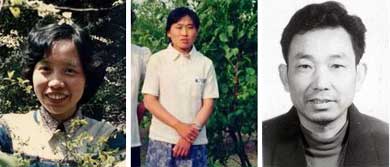
Ms. Gu Jianmin (left) Died after 13 Days in Custody on March 13, 2008. Ms. Hu Yanrong (center) Died Only 4 Days after Her Arrest on August 5, 2007. Mr. Sun Guanzhou (R) Died within a Week of Arrest on March 6, 2008

Canada Free Press: It is now clear that the Beijing Olympics Games did not help to improve human rights in China.

On the contrary, unknown thousands of innocent people have fallen victim to the Beijing Olympics. Knowing that it had the Olympics secured, the Chinese regime not only refused to honor the promise it made to improve human rights when it bid for the 2008 Olympic Games[1], but it used the Olympics’ security as a pretext to apprehend, torture, and murder people who had already suffered prolonged human rights violations in China.

One group of victims that the Chinese regime particularly targeted in the year leading up to the Beijing Olympics is Falun Gong practitioners[2]. The Chinese regime has consistently denied persecution of other groups, but has publicly vowed to “eradicate” Falun Gong. In April 2007, a secret document of the Public Security Department listed Falun Gong among 11 groups that were to be monitored and prohibited from attending the Olympics[3]. In February 2008, the Beijing Organizing Committee for the Games of the XXIX Olympiad issued an internal instruction to “strictly monitor and control Falun Gong.” Following these instructions, Chinese authorities all over the country intensified the persecution of Falun Gong practitioners.

In the following pages, we document the names and details of the arrest of over 10,000 Falun Gong practitioners in the name of the Beijing Olympics’ security. To fit within a reasonable space, we provide only a small number of the descriptions of how these victims have been violently and even fatally abused in custody. Because of the Chinese regime’s restrictions on the flow of information, the atrocities are feared to be much worse.

The report can be found at here:

These people have committed no offense. The majority of them were abducted when the police broke into their homes. Many were taken from their work. Some middle school and high school students were arrested in their dormitories and classrooms. They could not possibly threaten the Olympics from where they were arrested; many were hundreds or thousands of miles away from the venue.

The incarceration of Falun Gong practitioners was not at all to keep them away from the Olympics; it was to coerce them into renouncing Falun Gong. To that end, all of the arrested Falun Gong practitioners were severely tortured; some were beaten to death hours after their arrest. When their family members asked for their release, the authorities replied, “After the Olympics.” However, large numbers of Falun Gong practitioners are still in custody, long past the Olympics.

It should be clear from this report how the Beijing Olympics was used by the Chinese regime to intensify its persecution of Falun Gong. The same Olympics tragedies have happened to others, including Tibetans, Uyghurs, Christians, and human rights lawyers and defenders.

In presenting this report, and the evidence that it contains to show the deterioration of human rights in China, we remind those who rationalized rewarding the Olympics to Beijing as an opportunity to help human rights in China that they have a responsibility to come to the rescue of those who suffered the consequences of their failed rationalization.

This failed Olympics rationalization is but the latest entry in the long list of similarly failed rationalizations of the U.S. and the West’s policy of economic engagement with Communist China[4]. There have been numerous so-called opportunities over the past twenty years to help China to improve its human rights, yet with the passing of each opportunity, more victims have fallen to the Chinese regime’s human rights violations. Meanwhile, the makers of the engagement policy have simply walked away from the victims and moved on to the next “opportunity.”

Human rights improvement requires having a heart for the victims, a sense of responsibility, and the courage to stand up for what is right, rather than the excuse of so-called opportunities.

By repeating the same failure in China’s human rights and continuing to profit from these “opportunities” for financial gain, the economic engagement policy has become modern democracy’s worst example of hypocrisy. The complete lack of accountability also makes it modern democracy’s worst example of irresponsible politics.

It may therefore be fitting that beyond the Beijing Olympics there is no opportunity in sight to “help” improve the human rights situation in China. Instead the U.S. and the West are supplicating China to help them financially in the current deep financial crisis, as evidenced by the recent pleading of U.S. Secretary of State Hillary Clinton for China to continue buying U.S. debt. Going further than President Clinton’s delinking of human rights from trade with China, Secretary Clinton has openly delinked human rights from all China policy, stating that “those issues” can’t interfere with our more important goals, that “our economies are so intertwined,” and that, “We are truly going to rise or fall together. We are in the same boat and thankfully we are rowing in the same direction.”

Secretary Clinton is candid in openly admitting what human rights really means to the U.S.’s China policy, an inconvenient interference with other more important goals, yet it is sobering to see the top diplomat of the leader of the free world avow such a Faustian contract to rise or fall together with the most tyrannical regime of the world. Such a pledge is a betrayal not only to human rights, but to the very core of American values. Had America’s Founding Fathers cast aside “those issues” like unalienable rights, America would not have been conceived in liberty but remained intertwined with Great Britain. Had President Lincoln refused to let “those issues” like equality interfere with other “more important” goals such as avoiding a war and preserving a much more intertwined economy, the Union could just “rise or fall together” with the South, and there would be no President Obama.

However, more is at stake. Few may have noted how closely the collapses of Freddie Mac & Fannie Mae, Lehman Brothers, AIG and others followed on the heels of the Beijing Olympics to bring about the present financial crisis, and fewer may have considered that these scourges were not coincidental. Throughout history people with demonstrably higher moral standards have been more introspective in enlightening to the significance of tribulations. President Abraham Lincoln, in another mightier scourge, noted that the powerful interest of slavery was somehow the cause of the Civil War, and that both the North and the South at some point had contributed to the prolonging of that interest - “To strengthen, perpetuate, and extend this interest was the object for which the insurgents would rend the Union even by war, while the Government claimed no right to do more than to restrict the territorial enlargement of it.” Even when the Civil War came, most looked for “a result less fundamental and astounding.” Lincoln, however, saw that “The Almighty has His own purposes,” and that if God willed that the Civil War continue “until all the wealth piled by the bondsman’s two hundred and fifty years of unrequited toil shall be sunk, and until every drop of blood drawn with the lash shall be paid by another drawn with the sword, as was said three thousand years ago, so still it must be said ‘the judgments of the Lord are true and righteous altogether.’”

The U.S. and the West’s economic engagement policy with China may be less overt than the old slavery but no less immoral, for behind the pretext of human rights improvement is the profit from outsourcing to China’s modern slavery[5]. The Chinese regime not only entices the U.S. and the West to outsource to its modern slavery, but also bankrolls American consumers to buy China’s cheap slave-labor products by lending money to the U.S. through bond purchases. If the profit extracted from America’s old slavery had to be wiped out through the Civil War, could the financial gains extracted from China’s modern slavery at the expense of the Chinese people’s worsening rights be treated differently and written off by selling more bonds to China? If the current financial crisis is a warning of our moral decline in profiting from China’s modern slavery, what might be at stake in continuing down this wrong path? Needless to say, it is when a country is less inclined to believe in higher principles that its officials will consider to “rise or fall together” with a godless and criminal regime. But will the higher principles be less true just because we believe in them less? Will God be less just merely because human beings become less spiritual and more material?

It may be expedient and even tempting to remain silent to the Chinese regime’s human rights abuses in exchange for some financial gains, but, wittingly or unwittingly, those who place lining their pockets over values are themselves victims of the Chinese regime’s crimes against conscience[6]. Falun Gong practitioners, Tibetans, Uyghurs, Christians, and human rights lawyers and defenders have been victimized and lost their freedom because of their refusal to conform to the abusive regime, but those who choose to be in the same boat and rise and fall with such an abusive regime have lost their conscience.

In presenting this report and asking the free world not to forget these victims, we hope the free world may come to see its own falling victim to the Chinese regime’s crimes against conscience. This report is also a tribute to Falun Gong practitioners’ courageous defense of human conscience. They are a beacon to us all. Many Falun Gong practitioners in China have risked all to expose the violations they or fellow practitioners have suffered. Their reports must not be taken lightly, lest the values of hope, courage and human beings’ most fundamental right to conscience be forsaken. It is our earnest hope that in helping them the free world will find its way back to the true spirit of humanity.

[1] Liu Jingmin, Vice President of the Beijing Olympic Bid, said in April 2001, “By allowing Beijing to host the Games you will help the development of human rights.”
[2] United States Congressional-Executive Commission on China Annual Report 2008, Page 143
[3] http://chinascope.org/main/content/view/339/148/
[4] “Enticement and Engagement? from Falun Gong, Humanity?s Last Stand, Conscience Foundation, 2006, Page. 21.
[5] “Enticement and Engagement” from Falun Gong, Humanity’s Last Stand, Conscience Foundation, 2006, Page. 23.
[6] http://www.falunhr.org/newsletter/AgainstConscience.pdf
OLYMPIC WATCH: Human Rights in China and Beijing 2008

Sunday, March 29, 2009

China 'deploys mobile execution vans'

12:30 AEST Sun Mar 29 2009

Mobile "death vans" are being deployed across China in what officials say is a "civilised alternative" to the traditional method of execution for death row prisoners, according to a report in a British newspaper.

Amnesty International has condemned the practice saying "there is strong evidence" Chinese authorities run a lucrative side business out of the vans by harvesting the organs of dead prisoners.

The vehicles, which can reach top speeds of 128km/h and look like an operating theatre inside, are cruising China's streets to make executions more cost-effective and efficient, The Daily Mail reports.

The vans are thought to have been launched after hushed trials before the Beijing Olympics.

"We have gathered strong evidence suggesting the involvement of Chinese police, courts and hospitals in the organ trade," an Amnesty International spokesperson was quoted as saying.

"The bodies cannot be examined. Corpses are driven to a crematorium and burned before independent witnesses can view them."

The prisoner is reportedly strapped to an electric-powered stretcher before a team of doctors administer drugs and then reportedly "harvest" the lucrative organs — eyes, kidney, liver, pancreas and lungs which are left pristine condition.

The British Transplantation Society has also condemned China in the past for harvesting prisoners' organs.

Annual executions in China are expected to rise from 1715 to around 10,000 in the next few years as more people are convicted for the 68 crimes, including tax evasion, that are punishable by death.

But the designer of the van, Kang Zhongwen, said the vehicles were "promoting human rights" as the executions were carried out more "quickly, clinically and safely" than the traditional gunshot to the head.

Jinguan Auto manufactures the high tech vehicles along with their bullet-proof limousines.

"We have not sold our execution cars to foreign countries yet but if they need one they could contact our company directly," the Daily Mail quotes a spokesman as saying.

OLYMPIC WATCH: Human Rights in China and Beijing 2008

GhostNet: Massive China-Based Internet Spy Network Unearthed

By Suman Srinivasan
Epoch Times Staff Mar 29, 2009

Print E-mail
GhostNet report by Information Warfare Monitor group
A screenshot of the GhostNet report released by the Information Warfare Monitor group in Canada. (Suman Srinivasan/Epoch Times)


NEW YORK—On March 29, a Canadian research group unveiled a chilling report confirming fears that Chinese dissident communities have harbored for years—the presence of a vast, unrivaled online spy network that is able to track highly specific data and send it back to control servers based in China.

The research was conducted by the Information Warfare Monitor, a public-private research group that comprises researchers from two institutes in Canada: the SecDev Group, an operational think tank based in Ottawa, and the Citizen Lab at the Munk Center for International Studies, University of Toronto.

Their 53-page report, titled “Tracking ‘GhostNet’: Investigating a Cyber Espionage Network,” documents their findings of a global online espionage network that relies on cleverly forged e-mails to infect target computers, control them, and then send reports back to control servers, most of which are based in China.

The group reported that their work started when they began investigating computers in Tibetan exile centers in Dharmasala, India, for possible compromises. The work they did “led to the discovery of insecure, web-based interfaces to four control servers” which allowed attackers to control compromised machines.

Scouting these control servers resulted in their finding a vast network of compromised computers across the world—the report counted “at least 1,295 infected computers in 103 countries.”

Most interestingly, a large number of compromised computers were extremely high-profile targets: close to 30 percent of the compromised computers belonged to “ministries of foreign affairs of Iran, Bangladesh, Latvia, Indonesia, Philippines, Brunei, Barbados, and Bhutan; embassies of India, South Korea, Indonesia, Romania, Cyprus, Malta, Thailand, Taiwan, Portugal, Germany, and Pakistan; the ASEAN (Association of Southeast Asian Nations) Secretariat, SAARC (South Asian Association for Regional Cooperation), and the Asian Development Bank; news organizations; and an unclassified computer located at NATO headquarters.”

Leveraging Social Means

The researchers found that GhostNet spread by infecting computers with a trojan known as “gh0st RAT” that gave the attackers complete control over the infected system. They found that the Trojan was capable of “taking full control of infected computers, including searching and downloading specific files, and covertly operating attached devices, including microphones and web cameras.”

Such complete takeovers would allow the attackers to even hear and see events happening on the compromised computers.

The Trojans were obfuscated malware, resulting in their being difficult to detect in commercial anti-virus and anti-malware programs. “Only 11 of the 34 anti-virus programs provided by Virus Total recognized the malware embedded in the document. Attackers often use executable packers to obfuscate their malicious code in order to avoid detection by anti-virus software,” the report said.

The attackers used “social means” to spread the Trojan. For instance, “contextually relevant emails are sent to specific targets” and these e-mails, once opened, installed the Trojan on the unsuspecting user’s computer.

Targeting Chinese Dissidents?

The unearthed global Trojan network is only the latest in a series of massive cyber-attacks that have been based out of Communist-ruled China. In 2003, the United States Department of Defense (DoD) and numerous defense companies came under heavy attack in an operation that the DoD called “Titan Rain,” and has been under attack ever since.

Attacks originating from China have also targeted non-governmental groups and Chinese dissident groups. The report said that the attacks have targeted “organizations advocating on the conflict in the Darfur region of Sudan, Tibetan groups active in India, and the Falun Gong.”

The Citizen Lab has previously been involved in other studies involved Chinese cyber espionage. In October 2008, they published a report called “Breaching Trust,” which focused on the behind-the-scenes surveillance of chat sessions by TOM-Skype in China. The lab is also behind “psiphon,” which allows uncensored Internet access in OLYMPIC WATCH: Human Rights in China and Beijing 2008

Friday, March 20, 2009

Where is Gao Zhisheng?

Council on Foreign Relations - Beijing Must Reveal Fate of Human Rights Lawyer

South China Morning Post -March 19, 2009 - Author: Jerome A. Cohen, Adjunct Senior Fellow for Asia Studies

It is 43 days since the most recent "disappearance" of Gao Zhisheng, China's most famous human rights lawyer, who boldly sought to use the law to battle corruption, overturn illegal property seizures, expose police abuses and defend religious freedom.

His captors - apparently the notorious guo bao, the "national defence" unit of China's public security agency - had threatened to kill the 44-year-old Christian activist during previous detentions marked by obscene torture. Beijing's continuing refusal to comment on Gao's fate makes his case resemble those of the "disappeared" in Latin American dictatorships.
Last week, Gao's wife, two children and sister arrived in the US after being smuggled out of China. Until their arrival, international attention on Gao's own safety had to remain muted. Mainland persecution had forced some cruel choices upon the Gao family. After closing his law firm and taking away his lawyer's licence in 2005, the regime convicted him of "inciting subversion" in late 2006 because of his open letters, essays, interviews and hunger strike condemning police treatment of the Falun Gong, Christians and others.

It then released him on a five-year suspended sentence to home surveillance that proved harsher than prison, not only for Gao but also for his wife and daughter. By late 2008, repeated secret police harassment and brutality had made both mother and daughter, now 15, so suicidal that the family decided that their survival depended on escaping from China. On Tuesday, the Foreign Ministry denied it had persecuted the family.

It would have been impossible for Gao to leave with them. He was too closely monitored, and on many occasions his tormentors had warned him that he would never be allowed to leave China alive.

Early on February 4, 31/2 weeks after his family's departure, more than 10 police and thugs spirited Gao out of bed, and he has not been seen since. Nor has the Chinese government offered the slightest word about him despite repeated inquiries from UN agencies and foreign governments, non-governmental organisations and the media. Just before the UN Human Rights Council's February 9 review of China's record, the Canadian government formally questioned Beijing about allegations that its agents had tortured Gao and other human rights activists and lawyers. The Chinese government did not respond, either during the public hearing or subsequently.

The UN Working Group on Arbitrary Detention, which has many times condemned China in other cases, is reportedly pursuing Gao's case. Human rights NGOs have also asked for assistance from the UN Special Rapporteur on Torture, who interviewed Gao in late 2005 and who protested to the Ministry of Foreign Affairs about police attempts to interfere with the interview.

Unfortunately, Gao's situation has become so grave that it should easily warrant an urgent appeal for the prevention of loss of life by the UN Special Rapporteur on extrajudicial, summary or arbitrary executions. The release on February 8 of his previously unpublished account of the 13-day torture and subsequent further two-month detention to which he was subjected in 2007 only heightens concern for his life.

That account not only accused his captors of holding burning cigarettes to his eyes, beating and starving him, and applying electric shocks to his genitals, but it also revealed their warning that he would die if he told anyone about the ordeal.

Nothing similar to habeas corpus exists in mainland legislation or practice. But the UN Convention against torture, which Beijing ratified two decades ago, and its other international human rights commitments, obligate it to come clean about Gao. It is time for the court of world opinion to insist: "Show us the prisoner and justify his detention."

Jerome A. Cohen is co-director of New York University's U.S.-Asia Law Institute and adjunct senior fellow at the Council on Foreign Relations.

This article appears in full on CFR.org by permission of its original publisher. It was originally available here


OLYMPIC WATCH: Human Rights in China and Beijing 2008

Former China Intelligence Officer Tells His Story On Capitol Hill


Former China Intelligence Officer Tells His Story On Capitol Hill

By Gary Feuerberg
Epoch Times Staff
Mar 20, 2009
Share: Facebook icon Facebook Digg icon Digg del.icio.us icon del.icio.us StumbleUpon icon StumbleUpon
Print E-mail


Quitting the Chinese Communist Party
Fengzhi Li (L), former China Intelligence officer of the Ministry of State Security, speaks on Capitol Hill on how the Chinese Communist Party suppresses the Chinese people. He spoke through an interpreter. (Nancy Nieh/The Epcoh Times)


WASHINTGTON, D.C.—Chinese Intelligence Officer of the Ministry of State Security, Fengzhi Li, kept a low profile when he defected to the United States in 2004.

He was primarily concerned about the safety of his family, who were still on the Mainland. At the time, he needed to put some distance between himself and the Chinese Communist Party (CCP).

Then the human rights situation in China got “worse and worse,” he said. With access to the truth on how the Party suppresses the Chinese people, Li said he had to speak out to stop the killing and bring an end to a “brutal dictatorship.”

The solitude that Mr. Li enjoyed for five years ended abruptly. Last week on March 11, Mr. Li became the first person who had worked in China’s espionage system to publicly renounce his membership in the Chinese Communist Party. On March 15, Li was the focus of two rallies in the nation’s capital, celebrating the withdrawal of 51 million Chinese from the CCP or its affiliated organizations.

Then four days later, on March 19, Li followed up his public statements with an appearance on Capitol Hill to issue a new statement, which is even more vitriolic and accusatory of his former employer. He answered questions from the press, and received greetings and high praise from one of Congress’ leading human rights voices, Representative Dana Rohrabacher.

“In today’s China, political, economic and social power is highly monopolized. Except for the Communist Party, no other individuals or groups have any freedom or power, said Li.

He continued: “In order to control its monopoly, the Chinese Communist Party (CCP) has developed a political system that reaches every corner of the society and uses all kinds of bloody means to suppress Chinese people and other political groups.”

The picture that Li gives of China’s security system is one that doesn’t trust the people and thoroughly Orwellian.

“Employees of the national security system are supposed to protect the country and serve the country. But the CCP expends huge amounts of funds to suppress ordinary citizens and even extends the reach of their black hands overseas. In the past few years, to deal with the citizens who appeal for their rights, political dissidents, and spiritual groups, the CCP has increased its use of the state security systems to collect intelligence, carry out the monitoring, and so forth, even directly participating in arresting and persecuting those people.”

Li said that he and many of his colleagues at the Ministry of State Security, were “furious” at the CCP’s abuse of the country's resources to deal with decent Chinese folks. They ceased to trust and have confidence in the CCP.

Happiness is Not Only Economic Well-Being

One obstacle facing anyone who raises the issue of human rights atrocities in China is the common perception in the West that China has made tremendous progress economically, and that democracy and freedom are increasing with the economic expansion. This perception of China’ progress needs to be corrected, according to Li.

Fengzhi Li, 41, was raised in a materialistic, atheistic environment, where the education system instilled communist values to children. Due to the one child policy, Li had no brothers or sisters, and he said to this reporter that the way it is enforced is heartless.

Based on what Mr. Li said about the “pursuit of happiness,” a phrase out of the U.S. Declaration of Independence,” opposing the materialistic CCP has led Mr. Li to dwell on the “pursuit” of other values. He said that economic improvement is only one facet of “the pursuit of happiness.” Li says Chinese people should have the right to pursue their lives with dignity, pursue social justice, and pursue a spiritual life, like the free nations do in the West. He said that economic well-being cannot alone bring about true happiness.

“Today, when people around the world talk about China's economic growth, they should pay attention to the fact that China's economic growth has not brought about the social and political progress that it should have, and it has not brought ordinary Chinese people more freedom and political rights. The huge cost of the economic growth is worrisome, and it will eventually be paid by the Chinese people,” said Li.

When human rights are respected, China will have “genuine progress,” and it will benefit not only the Chinese people, but the world.

China’s Spies Can Lead To Its Own Undoing

China scholar and NTD-TV commentator, Dr. Tianliang Zhang said he was reminded by the account given by Mr. Li of a popular German film, The Life of Others, that portrayed the inner life of a spy and won the Academy Awards for the best Foreign Language Film in 2007. It’s about an agent working for the Stasi, the East German state police a few years before the fall of communism in the GDR. The agent, Captain Wiesler, is ordered to conduct surveillance on a dissident, who is suspected of pro-Western sympathies. But through getting to know him, the agent becomes sympathetic, and decides to distort and cover up for him in his reports to his superiors.

“An interesting aspect of this agent is that he is a faithful socialist,” says Dr. Zhang. He joined the Stasi because he felt that he was protecting the country from any potential enemies. In the end, he discovered the corruption of the communist leaders and understood humanity through listening in on the dissident writer.

“Today when we know Mr. Li Fengzhi's story, we can see that what is depicted in the movie came true [for Li Fengzhi],” said Dr. Zhang.

Mr. Li’s story demonstrates “a simple fact that if a person truly cares for the country and people, they know that the Communist Party is actually damaging the country and persecuting the people,” said Dr. Zhang. And there is also the potential that when the state police monitor the people, they are positioned well to know the truth because they have access to the censored news denied to the people, and they may witness firsthand the sufferings of the regime’s victims—people like the peaceful Falun Gong practitioners or a Christian like Attorney Gao Zhisheng.

Indeed, Mr. Li, as a former Intelligence agent, evolved in the same way as the fictional Stasi agent. Based on what he knows and on his understanding of what a free society should be like, Mr. Li says he is compelled to tell the West to awaken to the totalitarian nation that China has truly become. He tells us living in the West not to be fooled by the CCP and China’s great economic progress. He implores us to realize that the human rights abuses are only getting worse.

“When the international community engages with China, if we only focus on temporary economic … benefits, but keep silent on human rights issues, it is the same as supporting the CCP. ... From this perspective, keeping silent equals being accomplices to the CCP’s tyranny.”OLYMPIC WATCH: Human Rights in China and Beijing 2008

Tuesday, March 17, 2009

Matas: Canada’s CBC taking the Communist Party of China’s stance on Falun Gong???

National Post:

Posted: March 17, 2009, 5:21 PM by NP Editor ,

torture_art

When it comes to covering Falun Gong, both the English and French branches of CBC have adopted a view of the world disturbingly similar to that of the Communist Party of China.

Falun Gong is a spiritual movement that combines ancient Chinese traditions, Buddhist and Taoist practices, and qi gong exercises. Founder Li Hongzhi began writing and speaking about Falun Gong in 1992. The movement took off, growing to a Chinese government estimate of 70 to 100 million practitioners by 1999. The growth was partly attributable to encouragement by the Chinese government itself, which was impressed by Falun Gong’s health benefits.

But in 1999 then-President Jiang Zemin — out of jealousy that something an outsider proposed could become so popular while his own “Three Represents” writings languished in confusion and obscurity — spurred the government to ban the practice. To justify the banning, the Communist Party of China (CPC) developed a conspiracy fantasy. All those individuals engaging on their own or in small groups in harmless, indeed healthful, exercises, the CPC alleged, were part of some vast organization aimed at overthrowing communist rule.

The persecution began first by arrests, then by torture, then by disappearance. It did not take long, as David Kilgour and I concluded in a report released in July, 2006, for the disappeared to become the source of organs sold to transplant tourists for huge sums.

In 2007, the CBC announced that it was broadcasting a TV documentary by Peter Rowe on the persecution of the Falun Gong in China, which featured our report. But the government of China leaned on the CBC, and the CBC pulled the show. It was replaced in the scheduled time slot with an old documentary on Pakistan.

The CBC went back to the producer and asked for changes. He initially balked, and then made some edits. But the changes he made weren’t enough for Beijing. The CBC made more changes on its own after the producer refused to co-operate anymore, and then broadcast its concocted product.

Not to be outdone by the CBC, French-language Radio Canada went one further in a show that aired in Oct., 2008.

The origins of that broadcast originate with La Presse Chinoise, a Montreal-area Chinese weekly newspaper, which in 2001 published standard Communist Party propaganda against Li Hongzhi and the Falun Gong — material that was, according to the Quebec Court of Appeal, defamatory. The libels eventually led Falun Gong practitioners to protest in front of the offices of the La Presse Chinoise.

Radio Canada reported these protests in a way that would have warmed the heart of the most hardened Chinese Communist Party bureaucrat. Falun Gong was depicted as an organization that is “highly structured” with “no shortage of money,” composed of different organs working in lockstep. This mythical organization was then blamed for tension in Montreal’s Chinatown — because some practitioners had the nerve to protest their being libelled by La Presse Chinoise.

Radio Canada preyed on the ignorance of the Canadian public to propagate the Communist Party line, blaming the victims for protesting their victimization, adding to the propaganda by describing the Falun Gong as “little known and bothersome,” “whose presence creates malaise.”

Why are CBC and Radio Canada behaving as a mouthpiece for the Chinese Communist Party? Is it the identification of one bureaucracy with another? Is it nostalgia for the socialist values that the Communist Party used to embody?

Whatever the explanation, the distortions the public broadcaster brings to China and the Falun Gong are regrettable. When it comes to reporting on China and the Falun Gong, it is time CBC/Radio Canada started to reflect Canadian values instead of Chinese Communist Party values.

National Post

David Matas is an international human rights lawyer based in Winnipeg.

OLYMPIC WATCH: Human Rights in China and Beijing 2008

Thursday, March 12, 2009

More on Chinese Dissident Lawyer's Family Defects

2009-03-12

RFA: Gao Zhisheng took on China's legal system at great cost. Now his wife and children are seeking U.S. asylum.

WASHINGTON—The wife and children of a top civil rights lawyer under close surveillance by the Chinese authorities have arrived in the United States after walking across the border to Thailand, Gao Zhisheng’s wife Geng He said.

Geng said her daughter, 15, and son, 5, had suffered “great hardship” in China from living under virtual house arrest in their Beijing home.

“I left China because my family had been under tight surveillance for a long time. We experienced—in our careers and daily life—great hardship and difficulty,” Geng told RFA’s Mandarin service in her first interview since arriving in the United States on March 11 to seek asylum.

“My daughter was unable to attend school. Because she was unable to attend school, she tried to commit suicide several times,” Geng said. “I had no place to turn. So I fled with my children.”

Geng said she had left a note for Gao, an Army veteran who lost his law license after he criticized the government for its treatment of the banned Falun Gong spiritual movement.

Gao began a rolling hunger strike among fellow civil rights activists to protest the ill-treatment of lawyers and rights activists at the hands of police and local government officials.

“I left a note for my husband that I was leaving with the children,” Geng said.

“I said in my note that our daughter is miserable because she couldn’t attend school. I said I was miserable and I had to take the kids and leave,” said Geng, in tears.

Dangerous route through Thailand

Geng and her children left China on Jan. 9 and arrived in Thailand on Jan. 16, leaving for the United States on March 10.

Describing the family’s dramatic escape, Geng said they first left Beijing very quietly, unnoticed by the state security police who usually followed them.

[My daughter] tried to commit suicide several times..."

Geng He

“We could not travel by air. We took a train,” Geng said, adding that Gao was unable to accompany them because he couldn’t throw off the police on his tail.

“Eventually, with the help of friends, we freed ourselves from police surveillance and we walked to another country,” she said.

Geng said friends who helped her leave China were members of the banned Falun Gong spiritual movement.

“We walked day and night. It was extremely hard. I did not even know the names of some of the towns we passed through.”

“It was extraordinarily difficult to get us out of China. The friends who helped us escape took enormous pains, some even risking their own lives,” Geng said.

She said she hadn’t been in touch with Gao since leaving China.

“On Feb. 4, when we had arrived in the second country, I heard from a friend that he had been detained. I am very worried,” said Geng, who has no idea of Gao’s whereabouts.

‘Very fragile state’

Now in the United States, Geng said she has few specific plans.

“The first step is to get here and to give my daughter a chance to heal her mental scars,” she said.

“She is in a very fragile state. When she feels better, I will arrange for her to get an education. It’s important to get an education.”

She said her son asked repeatedly for Gao, and whether his father had been sent to prison again.

Gao’s whereabouts remained unclear for months after he was subjected to a secret trial by the authorities on unspecified subversion charges in 2006.

Lauded by China’s own Justice Ministry as one of China’s Top 10 lawyers in 2001 for his pro bono work in helping poor people sue government officials over corruption and mistreatment, Gao was once a member of the ruling Chinese Communist Party. He resigned from the Party in 2005.

Gao’s fortunes took a sharp downturn after he wrote an open letter to President Hu Jintao and Premier Wen Jiabao in October 2005 urging them to end the persecution of Falun Gong practitioners, detailing a range of abuses they suffer in custody, including torture, beatings, and execution.

Report on abuses

In its most recent report on human rights around the world, the U.S. State Department noted that Gao’s whereabouts remained unknown.

It also noted the authorities had revoked the professional licenses of several prominent lawyers, including Gao and of Teng Biao, who offered to represent Tibetans taken into custody for their role in the March 2008 Tibetan uprising in Lhasa.

“Government-employed lawyers often refused to represent defendants in politically sensitive cases, and defendants frequently found it difficult to find an attorney,” the report said.

“Officials deployed a wide range of tactics to obstruct the work of lawyers representing sensitive clients, including unlawful detentions, disbarment, intimidation, refusal to allow a case to be tried before a court, and physical abuse.”

OLYMPIC WATCH: Human Rights in China and Beijing 2008

Wednesday, March 11, 2009

The Administration Kowtows Are the Chinese people alone now?

by Ethan Gutmann
03/16/2009, Volume 014, Issue 25

Weekly Standard: Over the last three weeks, the Obama administration has sent three clear signals to the Chinese leadership.

First came the news that Chas Freeman would chair the National Intelligence Council. The former U.S. ambassador to Saudi Arabia and an adviser to CNOOC (the state-owned Chinese oil company), Freeman clearly fits the Chinese Communist party's idea of a four-year plan for American intelligence oversight. Just note Freeman's curious 2006 statement about the Tiananmen massacre. It is unacceptable "for any country to allow the heart of its national capital to be occupied by dissidents intent on disrupting the normal functions of government, however appealing to foreigners their propaganda may be." That particular trope was originally laid down by Henry Kissinger, and it's considered safe for public use. Freeman, though, took the argument to its logical conclusion, condemning the "ill-conceived restraint" and "overly cautious behavior" of the party leadership.

I thus share the hope of the majority in China that no Chinese government will repeat the mistakes of Zhao Ziyang's dilatory tactics of appeasement in dealing with domestic protesters in China.

It's not hard to predict what line the intelligence community will take on China's military buildup (or another Tiananmen) under Freeman's leadership.

The Chinese will score their number two victory with Gary Locke, former governor of Washington, becoming our new commerce secretary. Locke's been a very--very!--good Friend of China: making public displays of affection for the party's brilliant stewardship, carrying a torch for China in the Beijing Olympics relay, and easily straddling his public

and private interests to make a deal. Locke has paraded his guanxi--his connections--and, indeed, his numerous meetings with Hu Jintao are real. As are the campaign funds he got in the 1990s through Buddhist temple fundraisers, Chinese cut-outs, and confessed felon John Huang. This may have knocked Locke out of contention for a spot on the Gore 2000 ticket, but apparently it was of little interest to Obama's third-time-lucky vetting staff in 2009.

To complete the hat trick, Secretary of State Hillary Clinton made a seemingly offhand comment on the eve of her recent trip to Beijing. Discussion of Taiwan, Tibet, and human rights would be "on the agenda," she said. But "We pretty much know what they are going to say." Some commentators have labored to present those words as refreshingly plainspoken. Bringing up human rights to the Chinese government is just an empty ritual the argument goes, and America has larger interests at the moment--China's purchase of treasury bonds, a "partnership" on green technologies--which speak to a much broader, "global" definition of human rights.

But rituals, and the spirit in which they are carried out, matter very much to the Chinese leadership. Chinese citizens, particularly those who dissent, pay close attention as well. Even if Clinton has tired of Chinese human rights (in the old-fashioned definition, where people are tortured to death and so on), the act of unilaterally agreeing to ignore an actual source of tension between our two societies represents a notable change in U.S. policy. The repercussions will extend far into Taiwan, China, and America.


Taiwan, in particular, faces trouble. China's internal crisis of collapsing exports and exploding unemployment would squelch any tendency toward foreign adventurism in most societies. But the Chinese government remains perfectly willing to go to war if they can unify the population and extend the party's control. Its objectives are clear. It wants to prevent Taiwan from being becoming the locus of the Chinese diaspora's resistance. The Chinese reward Taiwanese single-party rule with economic favors to prevent any onset of the democracy cancer when Taiwan is absorbed into the Chinese bloodstream. The current Taiwanese leadership is playing into the scenario by expanding economic contacts, attempting to wring the last Renminbi from the mainland, while intently working over their discredited opposition party to the last man.

As the first viable Chinese democracy in history drifts into genuine peril, it cannot rely on the U.S. president who appears to dislike even using the D-word and needs Chinese cash for his own internal adventurism. The Chinese have an estimated $2 trillion in foreign exchange reserves.

On the mainland, the Obama administration is giving the party a free hand exactly when they need it. The party must keep disparate forces--labor groups, Falun Gong, Christians, democracy advocates--isolated from one another. The tool is surveillance--using the Internet, phones, indeed, any electronic device that can track humans. (Many of these technologies originally came from American companies.) Once dissenters are arrested, the party needs to squelch any legal defense. Dissident lawyer Gao Zhisheng, freshly out of detention after severe torture, recently disappeared again.

Organ harvesting--particularly if the liver, kidneys, and corneas are surgically removed while a prisoner is alive--creates a foreign currency stream for the military. For the Chinese state it also solves a problem: Approximately 100,000 incarcerated Falun Gong, and an unspecified number of Eastern Lightning (Christians) will not give up their beliefs. Release is impossible; they are dangerous enemies of the state. In the marriage of the New China's capitalism and the party's unchanging authoritarianism, organ harvesting has become a profitable form of barbarism.

The last time an administration gave such an explicit green light to the Chinese leadership was three weeks after the Tiananmen Square massacre. George H.W. Bush sent National Security Adviser Brent Scowcroft and Deputy Secretary of State Lawrence Eagleburger to Beijing to reassure the Chinese. Again, the message was that human rights and democracy didn't really matter, only business, only partnership. (That Scowcroft had to deliver it in secret, though, is another sign of how far things have deteriorated.) When this became public some months later, many conservatives broke ranks and some liberals joined them in creating a firestorm of criticism for the administration's policy.

And today? Nancy Pelosi cut her teeth on China human rights, but she won't break ranks without sustained pressure. Amnesty International has made some noises about Clinton's comments. To a lesser extent, so have Freedom House, Reporters Without Borders, and Human Rights Watch. But it's not nearly enough. And where are the AFL-CIO, the academy, and the sweatshop coalitions?

Human rights in China. Democracy in China. These are things that the Obama administration wants nothing to do with. Are the Chinese people on their own now?

Ethan Gutmann, an adjunct fellow at the Foundation for Defense of Democracies, is completing a book on the conflict between the Chinese state and Falun Gong.


OLYMPIC WATCH: Human Rights in China and Beijing 2008

Gao Zhisheng’s Wife and Children Arrive in the U.S.

Epoch Times Staff Mar 11, 2009
Share: Facebook icon Facebook Digg icon Digg del.icio.us icon del.icio.us StumbleUpon icon StumbleUpon
Print E-mail
Related articles: China > Democracy and Human Rights

Gao Zhisheng, his wife, Geng He and two children. (The Epoch Times )
Gao Zhisheng

Updated 5:51 p.m. EDT, March 11, 2009

According to the Global Association for the Rescue of Gao Zhisheng, China’s famous human rights lawyer's wife Geng He and their two children arrived in New York on March 11.

The Friends of Gao Zhisheng and the Global Association for the Rescue of Gao Zhisheng indicated that Geng He and her two children entered Thailand and immediately filed for an asylum application with the U.N. Refugee Agency. They were then speedily accepted as refugees by the U.S. government and safely arrived in the United States on March 11.

Ms.Sherry Zhang of the organization Friends of Gao Zhisheng expressed deep concern for the well being of the family” “This family has suffered greatly, particularly the daughter. She is a 16 year old child who has suffered physical and mental abuse at the hands of the Chinese regime. The son is five and one-half years old, and has also suffered. He tends to be very emotional.

“The family needs a stable life. We are very happy the U.S. government has helped them.”


Ms. Zhang also commented on how the family’s escape will affect Gao Zhisheng: “The Chinese regime has been using the family as a hostage . We are sure that their being in the United States is a big comfort to Gao. We don’t know his exact whereabouts but believe he is in the hands of the police.

“We also believe he is being brutally tortured right now, and we are now even more concerned about his safety. The Chinese regime may even try torture him even more to try to find out the location of this family.”

The Friends of Gao Zhisheng and the Global Association for the Rescue of Gao Zhisheng expressed special thanks to those who have helped in the rescue of Geng He and her two children. Special thanks were also given to the U.S. government who quickly approved Geng He’s application and admitted them into the U.S. They also expressed gratitude to the U.N. Refugee Agency.

To help Geng He and her family, The Friends of Gao Zhisheng and the Global Association established a “Gao Zhisheng’s Family Aid Foundation.” The account information is as follows:

Future China Foundation, a special account for the support of Gao's family: 781817259
Check title: Future China Foundation
40-46 Main Street, Suite 201, Flushing, NY 11354 USA
Routing No: 021000021
Swift No: Chasus33 (foreign wire)

Read this article in Chinese

OLYMPIC WATCH: Human Rights in China and Beijing 2008

Tuesday, March 03, 2009

VISION, PRINCIPLES AND RESPONSIBILITY IN LEADERSHIP: D. KILGOUR


Remarks by Hon. David Kilgour, J.D.

Queen's Canadian Leadership Conference 2009

Queen's University

Kingston

24 January 2009
---------------------------------------------------------------------------
Congratulations to Queen's on this conference. Also for using it to support the Stephen Lewis Foundation, which is doing much to ease the pain of the HIV/AIDS pandemic among our sisters and brothers in Africa.

Your topic could hardly have been more timely in the week of the inauguration of President Barack Obama as the 44th American president. He appears to carry the confidence and hopes of even more Canadians and others around the world than he does Americans. It is truly the beginning of renewal for both America and the world.

Vision
Words from scripture--"Without a vision the people perish"--are carved onto an outside wall of the peace tower in Ottawa. Our ancestors certainly viewed vision as imperative for our nation and a responsibility for leaders. Voters, however, are able to detect soon enough when a "vision" is promoted only to advance a political agenda.
Visionary, disciplined and responsible leadership is hard to define, but most of us recognize it when we see it in someone like Obama.

Obama's victory is ultimately a result of his vision.

In his inaugural address, the new president described how the American people "have chosen hope over fear, unity of purpose over conflict and discord." He reminded us that "without a watchful eye, the market can spin out of control -- and that a nation cannot prosper long when it favors only the prosperous." He called on us to share the responsibility and work hard toward the great ambitions and imagination of humanity. "Greatness is never a given. It must be earned. Our journey has never been one of short-cuts or settling for less."

True to Principles
In both of his books, The Audacity of Hope and Dreams From My Father, Obama shares his leadership principles: honesty, fairness, equality, independent thinking and service to the public. One could add accountability, avoidance of political expediency and pursuit of excellence. I was deeply impressed by how his mother ingrained these principles in him. Consider this passage in Dreams:

"Increasingly, (mother) would remind me of ( father's) story, how he had grown up poor, in a poor country (Kenya), in a poor continent, how his life had been hard, as hard as anything that (stepfather in Indonesia) might have known. He hadn't cut corners, though, or played all the angles. He was diligent and honest no matter what it cost him. He had led his life according to principles that demanded a different kind of toughness, principles that promised a higher form of power. I would follow his example, my mother decided. I had no choice. It was in the genes."
"And it was in search of some practical application of these values (to "build community and make justice real") that I accepted work after college as a community organizer for a group of churches in Chicago that were trying to cope with joblessness, drugs and hopelessness in their midst."

His is a story of America's progress. It is also one that embodies our struggle to achieve a better world, a reality in which the pursuit of the inalienable right to human dignity for all will unite humankind. Leaders should never waver in their determination to achieve this goal.

Fighting for principles unfortunately is often an uphill battle in many parts of the world, a reminder of how precious is the rule of law and democracy Canadians and Americans often take for granted.

Aung San Suu Kyi
Another leader of principle who has inspired many around the world is Aung San Suu Kyi, the Nobel Peace laureate, who has spent most of 18 years under house arrest in Burma. She and her National League for Democracy (NLD) won about two-thirds of the votes cast in the 1990 election. The junta allowed none of the elected to take their seats. The UN Special rapporteur on Burma confirmed as a "state-instigated massacre" the attack on her peaceful procession in 2003, northwest of Mandalay, when about 100 people were killed; Suu Kyi was herself wounded. Humble yet extraordinarily determined, she has dedicated herself to the peoples of Burma and chosen to give up her family and freedom.

Gao Zhisheng
Gao Zhisheng of Beijing was also nominated for a Nobel Peace Prize. In 2001, he was named one of China's top ten lawyers. He donated a third of his time to victims of human rights violations, representing miners, evicted tenants and others. When, however, he attempted to defend members of the Falun Gong spiritual community, the party-state unleashed its full wrath. This included removing his permit to practise law, an attempt on his life, having police attack his wife and 13-year-old daughter and attempting to deny the family any income. In 2006, he was sentenced to three years in prison for "inciting subversion of state power", although international pressure appears to have caused a suspension of the sentence for five years. Predictably, Gao did speak out again and his whereabouts is now unknown to the great concern of many in China and elsewhere.
Halima Bashir
Dr. Bashir last year wrote the first memoir by a woman caught up in the ongoing Darfur genocide, which has already cost an estimated 400,000 lives and forced 21/2 million into camps: Tears of the Desert. A member of the Zaghawa African community, she was working as a village medical doctor when the Janjaweed Arab militias, with the support of the Sudanese government military, began attacking the Zaghawa savagely. In 2004, they raped 42 school girls--some as young as eight--and their teacher, who were treated by Bashir. When she broke the rigidly-enforced silence about what had happened, a horrifying sequence of events occurred to her. Her book is a call to action by the international community.

Under current economic pressures facing the world, we must remember the struggle of these courageous, principled leaders. Failure to support them would amount to forfeiting our own beliefs because there must be no geographic boundaries to human dignity and the rule of law.
"Suckers and Duckers"
Perhaps I might insert something here my mother used to say. The world, she felt, was made up of essentially two kinds of persons--those who ducked out when the going got tough and those who did not: the suckers. Woe betide those aligning with the duckers. In fact, her advice was useful in almost 27 years as an MP. Other principles followed are available on my website (www.david-kilgour.com) under "Rule of Law/Democracy"; one was "Don't give up if you believe a constituent's cause is just".

For example, about 20 years ago, someone was referred by a respected member of the Polish-Canadian community. After hearing his story, I decided to help and it became a long battle with officialdom, including: the Immigration, Justice and Solicitor General departments, CSIS and successive ministers of Immigration. Thanks to a series of tough minded volunteer lawyers and very determined staff in my office, Ryzard and Ella Paszkowski became Canadian citizens and are now doing well. The text of a book I wrote about the case with the assistance of these staff, Betrayal, The Spy Canada Abandoned, is on my website.


MPs are better judges than party whips about issues in their ridings. It is electors who send MPs to Ottawa. In the case of the GST bill, for example, several thousand constituents indicated in various ways their opposition to the proposed new tax. As a one-time tax lawyer, I was then (1990) personally convinced that it was not an efficient way to raise tax revenues. In the end, Dr. Alex Kindy and I voted against the GST bill and were immediately expelled by Brian Mulroney from the parliamentary Conservative caucus. In the ensuing election, only two Progressive Conservatives were elected across Canada; I was returned in the same riding as a Liberal. Many years later, I resigned from Paul Martin's Liberal caucus, having lost confidence in his leadership. I learned in short: don't abandon your principles and your voters even if it means leaving a political party-or two.


Leadership is Trust

Sound principles give leaders the ability to maintain the trust, respect and support of stakeholders, whether voters, fellow students, work colleagues, customers or whomever.

Many have blamed the economic turmoil across the world on investment bankers on Wall Street, in London and elsewhere--"captains of greed". I'd add that another major contribution to our present situation was made by leaders, including many political ones, who chose political expediency over responsibility. In "the fierce urgency now," to quote Obama again, we must demand that our leaders and officials demonstrate continuous responsibility.

Here are some suggestions:

Accountability and transparency
The decline of some major organizations, including Nortel, is often linked to a lack of accountability. I believe that leaders should, first and foremost, uphold accountability and transparency-- cornerstones that help to distinguish democracies from other governance models. One effective way of doing this is by establishing and enforcing sound policies to protect whistleblowers. Far too often, 'information patriots' risk their careers and jobs in heroic efforts aimed at safeguarding the public interest.
Canadians have produced a leader with tenacity, grace, good humour, intelligence and principles in Joanna Gualtieri. As a portfolio manager of Canada's diplomatic properties with the Department of Foreign Affairs and International Trade in the early 90s, she spoke to senior management about the abuse of the public trust in connection with a number of properties she had inspected abroad. Her work convinced her that gross mismanagement had cost Canadians very large amounts of money between 1986 and 1998; she did her utmost to have corrective remedies adopted by management. For this, she was ostracized and ultimately sent on leave without pay when she finally went public with her concerns as a whistle blower in mid-1998. More than 10 year later, Joanna is still fighting against a bureaucracy that seems to be more concerned about the implications of admitting to wrongdoing than respecting the public interest.

Joanna's story is only one of many courageous Canadian whistleblowers who need the support and protection of leaders. I encourage you to find out more about these individuals and their organizations, FAIR and Canadians for Accountability, among others. You can find links to both these organizations on my website.

Dedication to Service

Obama's background as a community organizer was the subject of both praise and derision during the US presidential campaign. In my opinion, dedication to public service is a trademark of responsible leaders.

There are also numerous examples of leadership and public service in business. I would like to refer to one who particularly inspired me. The late John Poole and his brother were the majority owners of Poole Construction Ltd. (now PCL Construction). When John Poole retired as CEO of the company, the two of them sold their majority stake to the employees rather than accept the highest offer. In the ensuing three decades, John Poole and his wife gave tens of millions of dollars to a host of cultural, educational, social and environmental institutions. When Poole died two years ago, columnist Paula Simons of the Edmonton Journal noted, "( Poole) believed that every (person) owed a duty to his fellow citizens. He understood that living in a city isn't just about occupying space--it's about participating in the life of a community. It's about taking responsibility for the future."

At a time when financial resources are shrinking, our communities will require even more help, particularly for their more vulnerable members. Leaders should set examples for us in giving their time, resources and energies to our communities.


Values and Pursuit of Excellence
Countless organizations have been harmed when their leadership ventured into new areas without adequately understanding their circle of competence. On the other hand, at Southwest Airlines, for example, both management and employees know what the airline is good at and stick to it: Low-cost reliable air transportation. The implication for principled leadership is to have a core set of convictions. Without that focus, leaders yield to all kinds of pressures and achieve little of use to anyone.
In other words, leaders must ensure that their organizations remain steadfastly loyal to their basic philosophies, their raison-d'ĂȘtre. At the same time, leaders must also prepare their organizations to change everything else in order to meet the challenges of a changing world.

Faith in values and the pursuit of excellence have been tested over time as the "magic" combination for organizations. This is equally applicable to democracies, which are only truly sustainable when the values of equality, human dignity and rule of law are upheld and when innovations are made in support of these values.

Maintain inclusive culture

When leaders strive to maximize the wisdom of their communities, their organizations achieve much. The strength of Obama's victory came as a result of the coming together of people of many origins, walks of life, and ages. The inclusive nature of the campaign organization has allowed the new president to avail himself of a network of talented people from which to fill about 7000 positions in his administration. This inclusiveness will allow him to stay close to the American public.
In successful businesses, inclusiveness can take on the form of no special "perks" for senior management only. Nucor Corp., one of the most-admired U.S. organizations, is a good case study. Every employee is a full member of Nucor's team. The "no favourites" philosophy is demonstrated by giving employees the same amount of vacation days and insurance coverage, and no one gets a company vehicle, aircraft or assigned parking spot. The freedom to try new ideas gives Nucor a distinct competitive edge: a creative, get-it-done workforce. As a result, Nucor has been honoured as one of "100 Best Corporate Citizens,", the "best in class", "Best Big Companies" for environmental responsibility, corporate ethics, fairness toward employees, accountability for local community and many other criteria.

Mistakes Leaders Make

I define a leader as someone who does a lot more than the minimum every day and who wants to make a positive difference as often as possible. In the pursuit of principles and vision, however, it is easy to make mistakes. Has Fizel has written an interesting book describing ten errors leaders make and I've certainly made them all. Here are three important ones:


1-Don't display a top-down attitude. "Because I am the boss" is not a successful strategy. Good leaders see themselves at the bottom of an inverted pyramid as servant leaders. Very often, the best of ideas come from people at the very bottom of an organization's structure because the front-line workers have a better knowledge of those they serve.

2-Don't put paperwork before people. For example, some managers object to interruptions, but the late and loved Henri Nouwen highlighted an older professor, who noted: " I have always been complaining that my work was continually interrupted, until I slowly discovered that my interruptions were my work." He also said, "People will never care how much you know until they know how much you care."

3-Don't forget that we all need affirmation, praise, compliments. Good leaders understand the power of the personal touch of kindness. They show respect, provide recognition and spend time with their team.

Conclusion

As our world charters uncertain waters in the face of enormous challenges posed by economic turmoil, racial conflicts and threats of terrorism, more effective efforts are required from all leaders.

More than ever, our nation, our world, demand that our leaders set their eyes on interests greater than that of their own, or their political party or organization. More than ever, leaders need to keep their eyes on the long-term vision for a better world of human dignity, equality and rule of law for all.

As we move forward, from the Kingston community that produced outstanding national leaders, including Sir John A. Macdonald and Flora MacDonald, let's all work to make sure that our leaders guide us with vision, principles and responsibility.
Thank you.
OLYMPIC WATCH: Human Rights in China and Beijing 2008